ASD vs ADHD

Autism Spectrum Disorder (ASD) and Attention-Deficit Hyperactivity Disorder (ADHD) are similar disorders, even on a genetic level. Consequently, there can be a lack of clarity when discussing them. This article will attempt to provide some clarity regarding important issues on this topic.

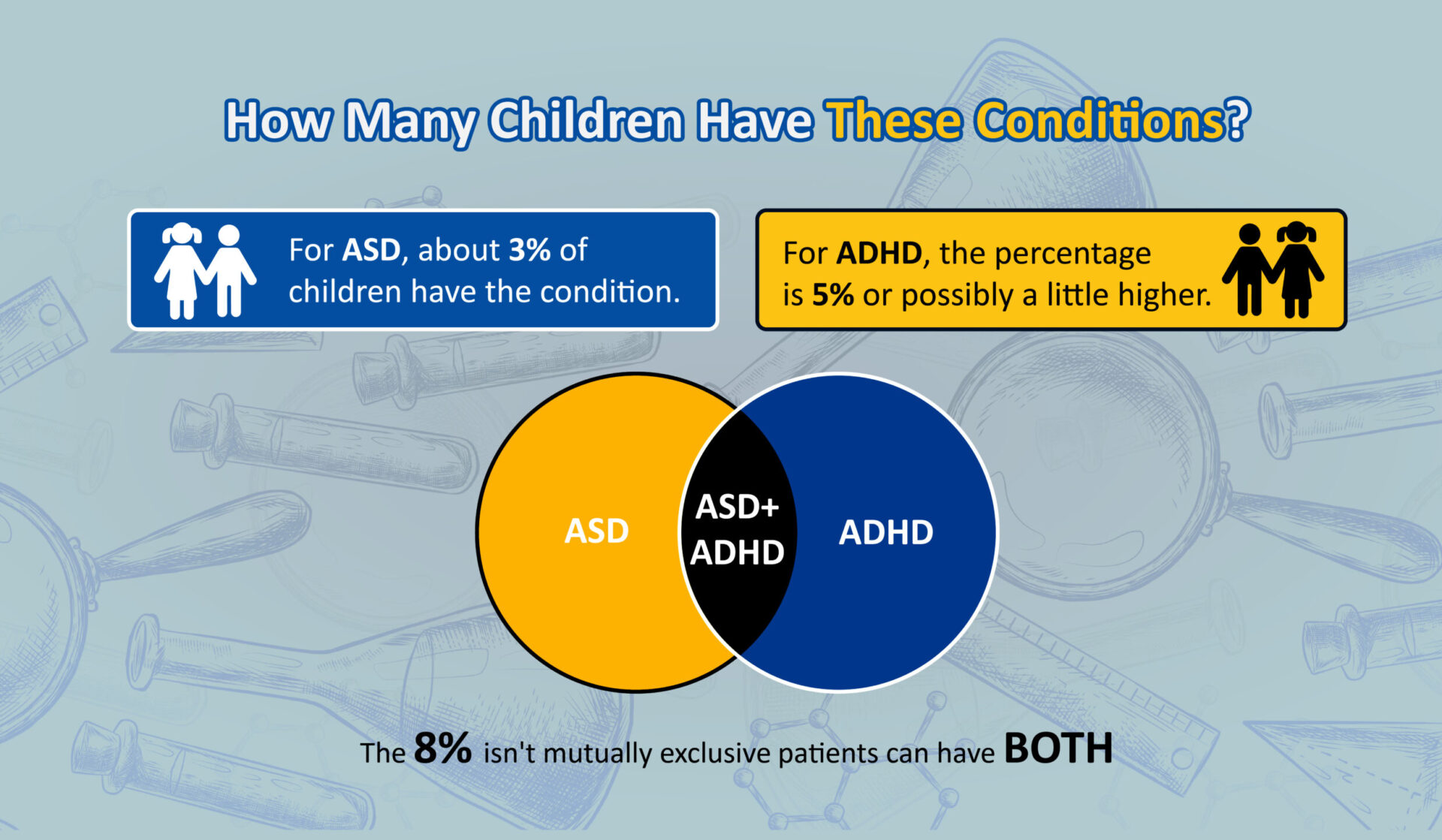
To begin with, let’s get a handle on how many children have these conditions. For ASD, about 3% of children have the condition. Whereas the percentage is 5% or possibly a little higher for ADHD. However, that does not mean that 8% of children have one or the other. That is because people can be diagnosed with both conditions. The data is fuzzy regarding the percentage of individuals with ASD who also have ADHD. Studies have placed the number between 30% and 70%.

Knowing that there can be genetic overlap between ASD and ADHD, it is no surprise that there are commonalities between them. They both have characteristic attention challenges, behavioral and sensory difficulties, and social challenges. However, there are some subtle differences. For example, individuals with ADHD often have the capacity to succeed socially, if they can pay attention. However, individuals with ASD struggle, even if their attention is strong. Those with ADHD are more likely to be distracted by external stimuli, while those with ASD are more likely to have attention difficulties due to hyperfocus on a special interest or sensory interference. People with ADHD are more likely to engage in fidgety-type behaviors to seek stimulation, while people with ASD are more likely to engage in repetitive behaviors to soothe themselves.

There are also meaningful differences in how these conditions are diagnosed. There are reliable objective assessments for ASD that can be used to diagnose ASD in children as young as two years of age, and new technology is pushing that age even earlier. For ADHD, diagnosis still relies mostly on rating scales and interview and is not all that reliable until the age of five. Consequently, in most cases where someone has both conditions, their ASD should have been treated before receiving treatment for ADHD. However, that sequence can be quite variable depending on one’s profile.

It can be difficult to identify symptoms of ADHD, as they often involve behaviors that can be seen in typically developing children as well. For example, most children can be overactive at times. However, for children with ADHD, their activity level is elevated most of the time, not just occasionally. With elevated hyperactivity, impulsivity, and inattention, children with ADHD often struggle in school due to difficulty focusing. Similarly, inattention and especially impulsivity can lead to social difficulties as well, as children with ADHD are often explosive, aggressive, bossy, break game rules, interrupt, and dominate conversations.

In the end, ADHD and ASD can co-occur and will likely require treatment for a child to reach their potential. However, for determining what a child’s condition is and recommending a course of action, an assessment is necessary. The good news is that professionals can be trained to do just that.  

Dr. David Fischer

Psy. D., CPBA-AP BCBA-D
Behavioral Consultant

Information provided by:

Dr. David Fischer received a doctoral degree in Clinical Psychology from Rutgers University, USA, advised by Dr. Sandra Harris. Since 1999, he was worked in the field of Applied Behavior Analysis and with individuals diagnosed with a developmental disability. He completed his pre-doctoral internship and post-doctoral fellowship at the Marcus Institute in Atlanta, Georgia working in the severe behavior unit, short-term-out-patient clinic, feeding disorders unit, and early intervention clinic. From 2007 – 2011, he trained public school teachers to instruct and manage the behavior of their students diagnosed with Autism spectrum disorder. He also was the clinical coordinator of the Asperger’s College Program, which provides support services to Rutgers students diagnosed with Asperger’s Disorder.

Related Articles:

Individuals on the autism spectrum vary greatly in how their autistic characteristics shape their life. Some individuals go through their entire life without receiving a diagnosis. On the other hand, some children demonstrate indicators shortly after birth and are diagnosed as young as assessments allow. This article explains how autism has been defined over time—and […]

Over the years, I have met many parents who come to me with the same question: “What is the difference between Autism Spectrum Disorder and Asperger’s Disorder?” Some parents tell me their child was diagnosed with Asperger’s, not autism. Others hear from friends or online sources that Asperger’s is milder and wonder whether their child […]

Is autism really less common in girls than boys? Should parents feel more relieved if they have a daughter? Why Fewer Girls Are Diagnosed With Autism Autism Diagnosis in Boys and Girls: What the Data Shows How Autism Often Presents Differently in Girls – Social Motivation, Language, and Behaviour Other Common Traits Seen in Girls […]

Please share to let more people learn about ASD and ABA therapy:

Thank You!

The form was submitted successfully

Thank you for contacting us

All information received will always remain confidential. We will contact you as soon as we review your message. Thanks

Thank You!

The form was submitted successfully

This site is registered on wpml.org as a development site. Switch to a production site key to remove this banner.